A side-by-side reading —
ECM Synchronika vs Rocket Mozzafiato Cronometro R.
Affiliate links · How we make money
At this price, you're buying consistency, not just capability. The single skill that separates success from frustration is temperature stability during back-to-back shots. Machines under $3,600 either have it or they don't—and it directly determines whether your milk drinks taste clean or muddy.
Dual-boiler and heat-exchanger designs dominate this tier for good reason. You'll pull espresso and steam milk simultaneously without temperature surfing. Build quality matters too. These machines cost real money. They should feel like they'll survive a decade of daily use.
The list below prioritizes machines that reduce variables, not add them. Simpler workflow. Better repeatability. Less fiddling between shots.
This guide is for people serious enough to spend four figures but not interested in modding their way to competence. It's not for espresso tourists or anyone still figuring out whether they actually want an espresso machine.
ECM
ECM Synchronika

Current price
$3,599
Rocket Espresso
Rocket Mozzafiato Cronometro R
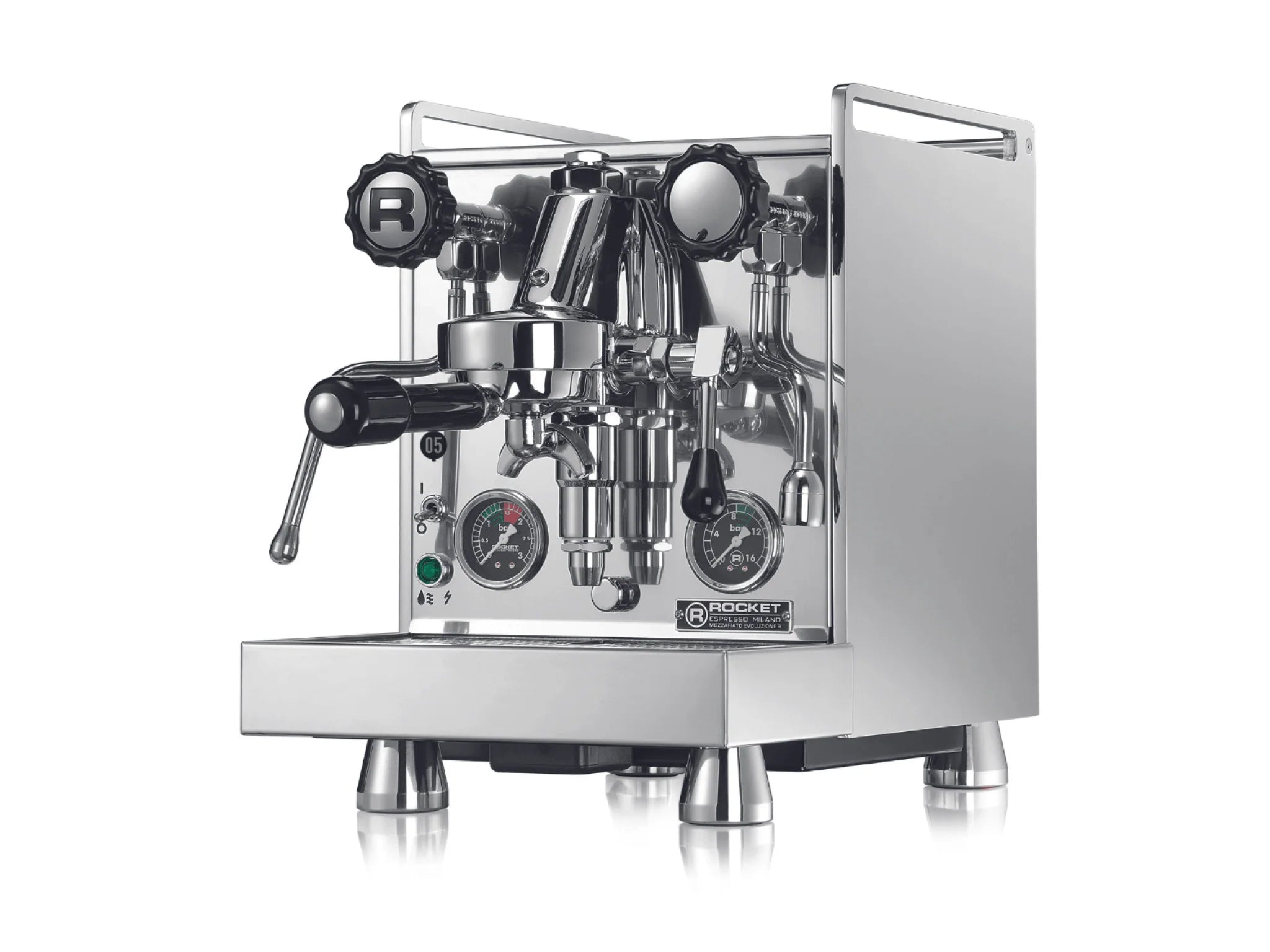
Current price
$2,900
The numbers, in full.
Every spec we've recorded for both machines. Highlighted rows decide most purchases.
- Current price
- $3,599
- $2,900
- MSRP
- $3,699
- $2,900
- Brand
- ECM
- Rocket Espresso
- From
- Germany
- Italy
- Skill level
- enthusiast
- enthusiast
Common questions.
- Is the ECM Synchronika worth the extra $700 over the Rocket Mozzafiato Cronometro R?
- The Synchronika's dual boiler system with independent temperature control justifies the premium if you regularly switch between espresso and milk-based drinks without waiting; the Cronometro R's heat exchanger is faster than older machines but still requires brief temperature surfing. For single-origin espresso or occasional cappuccinos, the Cronometro R delivers 90% of the experience at a lower price.
- Which machine is better for beginners: ECM Synchronika or Rocket Mozzafiato Cronometro R?
- The Rocket Mozzafiato Cronometro R is more forgiving for beginners because its heat exchanger design is simpler to dial in and its lower price reduces pressure to perform perfectly immediately. The Synchronika rewards technique with more consistency but demands slightly steeper learning curve with its dual boiler management.
- Can I make back-to-back milk drinks on the Rocket Mozzafiato Cronometro R without waiting?
- Not without a brief pause—the heat exchanger needs 20-30 seconds between espresso and steam to reach optimal milk-steaming temperature, though this is faster than single-boiler machines. The ECM Synchronika eliminates this wait entirely with separate boilers, making it genuinely better for high-volume milk drink workflows.
- What's the most common mistake buyers make choosing between these two machines?
- Overestimating how much they'll actually steam milk and paying extra for the Synchronika's dual boiler when a heat exchanger would serve them fine. Test your actual workflow first—if you make one cappuccino per session, the Cronometro R's brief temperature adjustment is negligible.
- Does the ECM Synchronika's rotary pump justify its cost versus the Rocket's vibratory pump?
- The rotary pump on the Synchronika delivers slightly smoother pressure curves and runs quieter, but both machines pull excellent espresso—this is a comfort upgrade rather than a quality one. If noise or micro-adjustments matter to you, the Synchronika wins; otherwise, the Cronometro R's vibratory pump is perfectly adequate.
Where else to look —
Cross-references.
Editor's verdict
The Rocket Mozzafiato Cronometro R is your default: dual-boiler reliability at a price that doesn't demand a second mortgage, and the saturated group handles milk drinks without temperature surfing. Jump to the ECM Synchronika ($3,599) if counter space allows—its larger footprint and superior thermal stability justify the premium for daily milk-heavy workflows. The Synchronika's needle pressure gauge and dual-boiler design eliminate guesswork on espresso consistency. Neither machine excels at single-dosing (both have traditional hoppers), so commit to a grinder-side workflow. Pick based on milk frequency: Rocket for occasional cappuccinos, ECM for multiple drinks per session.